
What Is an MDF Finish?
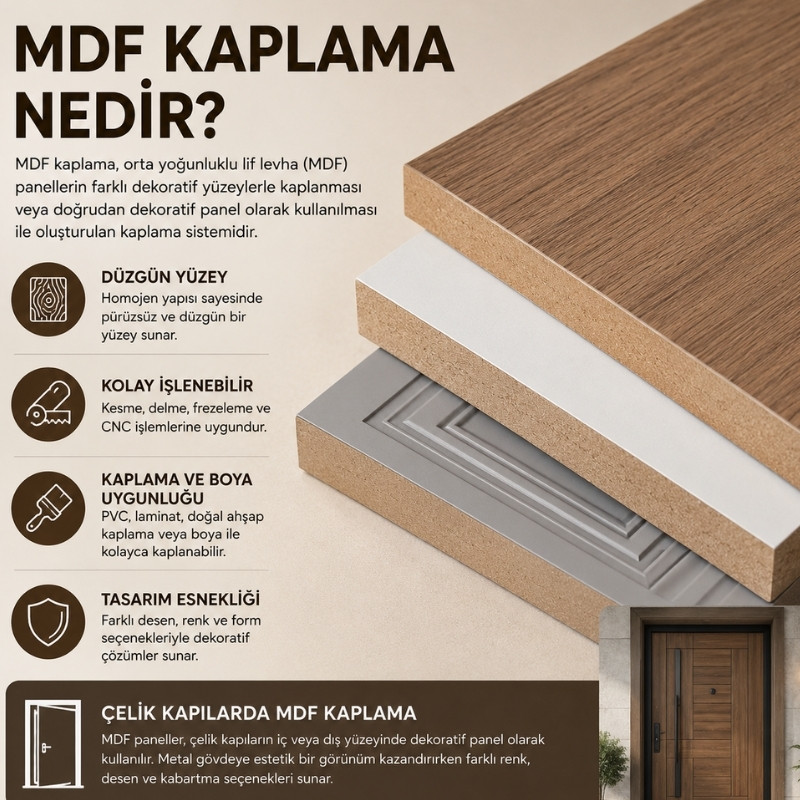
An MDF finish consists of medium density fibreboard finished with a decorative or protective surface. The smooth board is easy to machine and accepts various colours, patterns and finishes. This makes it useful in furniture, doors and decorative panels. In steel doors, an MDF panel adds a decorative finish to the metal body.
General Properties of MDF Finishes
MDF has a uniform fibre structure, with less variation in grain, knots and density than solid wood. This helps achieve consistent results when cutting or machining the surface.
Its smooth surface accepts paint, PVC film, laminate and natural veneer. CNC machining can produce geometric patterns, lines, grooves and other decorative details.
- Uniform structure: Consistent surface and density across the board.
- Smooth surface: Suitable for paint and decorative finishes.
- Machinability: Can be cut, routed, grooved and machined with CNC equipment.
- Pattern options: Allows raised or geometric designs on doors and furniture.
- Thickness options: Different thicknesses suit different uses.
- Finish compatibility: Works with PVC, lacquer, laminate and natural veneer.
- Repeatable production: Panels can be made in matching sizes and patterns.
| Property | Description |
|---|---|
| Surface | Smooth and uniform. |
| Machinability | Suitable for cutting, CNC machining, grooving and routing. |
| Finishes | Can be finished with PVC, laminate, melamine, natural veneer or paint. |
| Design flexibility | Supports modern, classic and decorative panels. |
| Applications | Furniture, doors, wall panels and other decorative products. |
Assess density, grade, thickness, edge treatment, surface finish and installation environment together when evaluating the finished product.
Where Are MDF Finishes Used?
MDF is widely used in furniture and building products because it is easy to shape and works with many decorative finishes. The best application depends on product design and conditions of use.
- Decorative panels for steel doors
- Interior doors
- Kitchen cabinet doors
- Wardrobes and hall storage
- TV units and furniture
- Office furniture
- Decorative wall panels
- Retail and interior fit outs
- Lacquered furniture surfaces
- Panels finished with PVC or natural veneer
MDF offers a smooth surface and design flexibility for indoor furniture. In door manufacturing, CNC machines can add lines, geometric shapes and decorative motifs to the panels.
An MDF panel on a steel door usually serves a decorative role. The steel body, frame, reinforcement profiles, lock, hinges and other structural components provide the main strength.
See Brango steel door models for examples of finishes, designs and decorative panels.
What Are the Benefits of MDF Finishes?
Manufacturers can use a plain MDF board, machine patterns into it or cover it with another material. A single type of base panel can therefore support many designs.
- Design flexibility: CNC cutting and routing can create different patterns.
- Even paint finish: Proper preparation helps achieve a uniform lacquered or painted surface.
- Choice of finishes: PVC, laminate, melamine and natural veneer can be applied.
- Repeatable production: Many panels of the same model can be made with consistent dimensions.
- Decorative appearance: Options include wood effects, matt, gloss, solid colours and other finishes.
- Size and shape: Panels can be cut and machined to project dimensions.
Consider the environment. Standard MDF and moisture resistant grades have different properties. Finish quality and edge protection can directly affect service life.
How Do MDF Finishes Compare with Other Surface Materials?
MDF is a board and a substrate for decorative finishes. For example, PVC finished MDF consists of a PVC film applied to an MDF board.
| Material or finish | Key characteristic | Typical use |
|---|---|---|
| MDF | Uniform wood fibre board | Used as a base panel or substrate. |
| PVC film | Decorative polymer film | Can be applied to panels such as MDF. |
| Laminate | Hard, durable decorative surface | Can be pressed or bonded onto a panel. |
| Lacquer | Smooth painted finish | Can be applied to MDF furniture and door surfaces. |
| Natural veneer | Thin layer of real wood | Can give MDF a natural wood appearance. |
| Melamine | Decorative surface impregnated with resin | An economical finish for furniture and panels. |
When comparing MDF with PVC, distinguish the substrate from the finish. MDF can serve as the main or decorative panel, while PVC is often the outer layer applied to it.
How Do MDF Finishes Perform Against Moisture and Impact?
Moisture performance varies by board grade and surface protection. Standard MDF is unsuitable for direct exposure to substantial water or prolonged high humidity. Water entering unprotected edges can cause swelling and deformation.
Protect the edges as well as the surface. PVC, laminate and paint can reduce direct exposure of the board to moisture. The level of water resistance still depends on the complete assembly.
- Dry interiors: Generally suitable for standard MDF applications.
- Areas with a risk of moisture: Choose a moisture resistant board with appropriate surface protection.
- Direct outdoor exposure: Use panels and finishes suited to rain, sun and temperature changes instead of standard MDF.
Impact performance depends on thickness, density, supporting structure, surface finish and the nature of the impact. In doors, evaluate the MDF panel together with the steel body and support behind it.
MDF Finishes on Steel Doors
An MDF panel can add a decorative surface to a steel door. The steel body provides the supporting structure and security, while MDF offers different colours, patterns and shapes.
MDF can be machined to create modern lines, classic motifs, geometric patterns and raised details. The panel can then be finished with PVC, laminate, natural veneer or lacquer.
Check these details when choosing a steel door with an MDF panel.
- Panel thickness and grade
- Finish applied to the panel
- Indoor or outdoor installation
- Edge protection
- Direct exposure to rain and sunlight
- How the panel is attached to the steel body
- Colour and pattern
- Fit with the frame and door leaf design
Decorative MDF panels offer many design options for sheltered apartment entrances. For villa and exterior doors, assess whether the panel and finish are suitable for the local climate.
Security depends more on the steel sheet, frame, internal reinforcements, lock, cylinder protection, hinges and installation than on the presence of MDF. MDF primarily provides the decorative surface.
Explore Brango steel doors for models, colours and decorative finishes.
Disclaimer. This article provides general information. MDF density, thickness, moisture resistance, surface quality and other technical properties vary by grade and manufacturer. Evaluate resistance to water and weather for the complete product. Before ordering a steel door, check the current specifications to confirm whether the MDF panel and finish suit the installation site.